
Which Oceanside Public Records Are Open
Oceanside is not the county seat, and most high-value record sets belong to San Diego County rather than the city. The city keeps its own council minutes, permits, local agency correspondence, and police reports. The consolidated San Diego County Assessor/Recorder/County Clerk holds the official-record index, property data, vital-record indices, marriage licenses, fictitious business names, and several professional filings. Court files, custody information, business entities, and licenses each have separate custodians.
| Record group | Office that keeps it | Web coverage | Practical access |
|---|---|---|---|
| Deeds, liens, official filings | San Diego Recorder/County Clerk | Index, 1970 to present | Index online; image by paid copy or kiosk |
| Civil, criminal, family, probate cases | San Diego Superior Court | Court Index, 1974 to present | Index, Register of Actions, courthouse request |
| Parcels and assessment roll | San Diego County Assessor | Current secured roll | Address/APN web search; ownership by phone or kiosk |
| Birth, death, and marriage | County HHSA/Recorder; CDPH-VR | No unrestricted current-copy index | Authorized or informational copy process |
| Jail custody and warrants | San Diego County Sheriff | Current public lookup | Name search with legal-use limits |
| Businesses and many licenses | California SOS and DCA | Statewide search tools | Free index; copies or filings may cost |
Open access still has boundaries. Juvenile and sealed cases are not public. Adoption files, confidential marriages, protected voter information, restricted motor-vehicle data, and parts of law-enforcement files follow special rules. A public index is also not the same as a viewable source document. That distinction matters most at the recorder and court.
Why Oceanside Records Go Countywide
The strongest Oceanside records desk is a county office with several roles. San Diego County joined the Clerk and Recorder in 1991, then consolidated that office with the Assessor after a 1993 charter change. The result differs from counties where a searcher must visit three unrelated departments. One ARCC system now routes deeds, parcel facts, marriage documents, birth and death indices, fictitious business names, and notary-related filings.
Municipal material stays with Oceanside. The City Clerk preserves legislative and agency records and uses NextRequest for California Public Records Act submissions. The city’s record history is unusually deep: its preserved minutes begin with handwritten Board of Trustees and City Council minutes dated July 10, 1888. Later minutes include meetings after major national events and continue through the modern Document Imaging System.
Use the city channel for council acts, local boards, permits, code files, and city correspondence. Use the county or state channel when the record arose from land ownership, a county vital event, a superior-court case, custody, or a statewide registration system.
Oceanside Recorder Index Access
The San Diego County Official Records Index covers recorded real-property documents from 1970 to the present. It returns indexed facts, not the instrument image. To read the deed, lien, affidavit, or other filing, order a copy for mail delivery or use a public kiosk at a county office. Online ordering requires an account and cart; the county prints orders the next business day and sends them by regular mail.
| Search control | Input | Required? | How it works |
|---|---|---|---|
| Grantor or grantee name | Text | One search mode | Try the indexed party name, often surname first |
| Document number | Number | Optional | Direct route to a known filing |
| Recording year or date | Date | Optional | Narrows results within 1970-present coverage |
| Document type | Type choice | Optional | Separates deeds, liens, and other instruments |
| APN | Kiosk only | Not online | Removed from the public web search in 2024 |
For mail copies, give the document number, recording year, at least one party name, and document type. Send a written request with check or money order to San Diego Recorder/County Clerk, ATTN: Real Estate Records, P.O. Box 121750, San Diego, CA 92112-1750.
Note: Grantor means the transferring party, while grantee means the person or entity receiving the recorded interest.
Oceanside APN Searches Moved Offline
San Diego County removed Assessor Parcel Number searching from its online recorder index on December 9, 2024, citing Assembly Bill 1785 and the California Public Records Act. APN searching did not vanish. It remains available at public kiosks in the county’s five offices. Online users must now rely on party name, document number, recording date, or document type.
This creates a real split between property and deed systems. The assessment roll and GIS tools can still identify a parcel by address or APN, but that APN cannot be carried into the recorder’s web index. A kiosk visit restores that route. For a remote request, translate the parcel lead into an owner name or known document details before searching or mailing the recorder.
Search-name tip. County Owner Alert examples use surname-first names and normalized prefixes. Try initials, suffixes, trusts, business names, and variants of multi-part surnames.
Oceanside Property Records Channels
The secured assessment roll accepts parcel number, address, or street name. Its 2026 information reflects assessor records as of June 30, 2026, so a later change may not appear. The web result provides parcel and assessed-value data. Ownership, address information, and parcel maps are also available through the Assessor Public Information Line at (619) 236-3771 and through office computer kiosks.
The San Diego County secured assessment roll shows the actual public form used for Oceanside parcels.
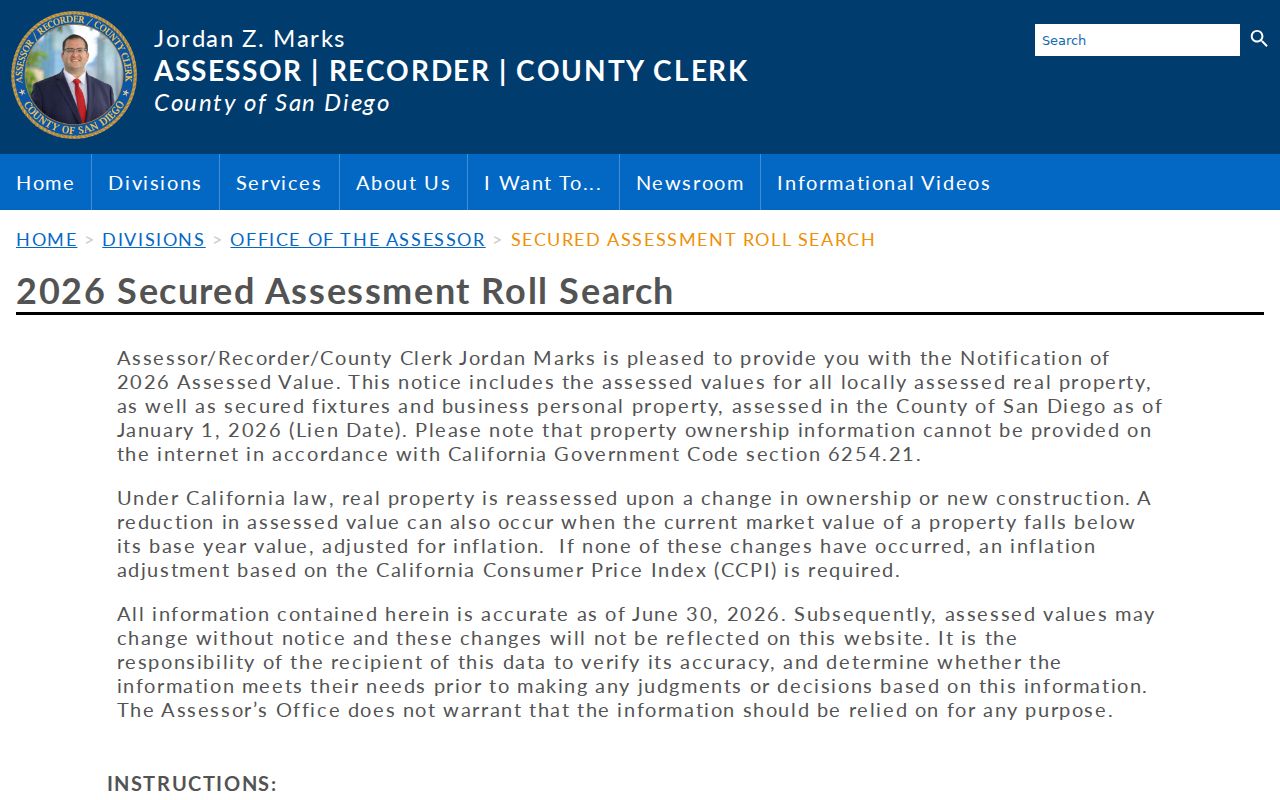
Its three search paths make the roll useful when either a street, exact address, or APN is known, while the phone and kiosk routes fill the ownership gap.
Oceanside Court Records Use Separate Rules
San Diego Superior Court files are governed by court access rules, not CPRA or federal FOIA. The Court Index searches civil, criminal, family, mental health, and probate matters from 1974 forward. Results can show the case title, number, location, type, filed date, and parties. Juvenile matters, sealed cases, traffic and minor offenses, and pre-1974 cases do not appear there.
Older access is substantial but offline. Central Division Older Records keeps indexes from 1880 to mid-1974. The 1880-1964 portion is in hardbound books, and the post-1964 segment uses computer-generated indexes. Microfilm may be available at the court location, but staff do not conduct the film research. Hard-copy viewing requires the court form and valid photo identification. If a non-party search takes more than ten minutes, Government Code section 70627(c) allows a search fee.
Probate has a special human use. Case files can identify estate representatives and heirs. Yet an original will deposited with the court cannot be viewed without a court order or proof of death through a certified or informational death certificate.
Oceanside Vital Records Copy Rules
California does not treat a recent vital record as simply open after a set age. It offers authorized certified copies to eligible people and informational certified copies to others. An informational copy is marked as invalid for establishing identity. Authorized copies require the relationship or eligibility set by Health and Safety Code section 103526, and state applications require a notarized sworn statement when one is needed.
The San Diego County certificate page explains the county paths for birth, death, and marriage records.
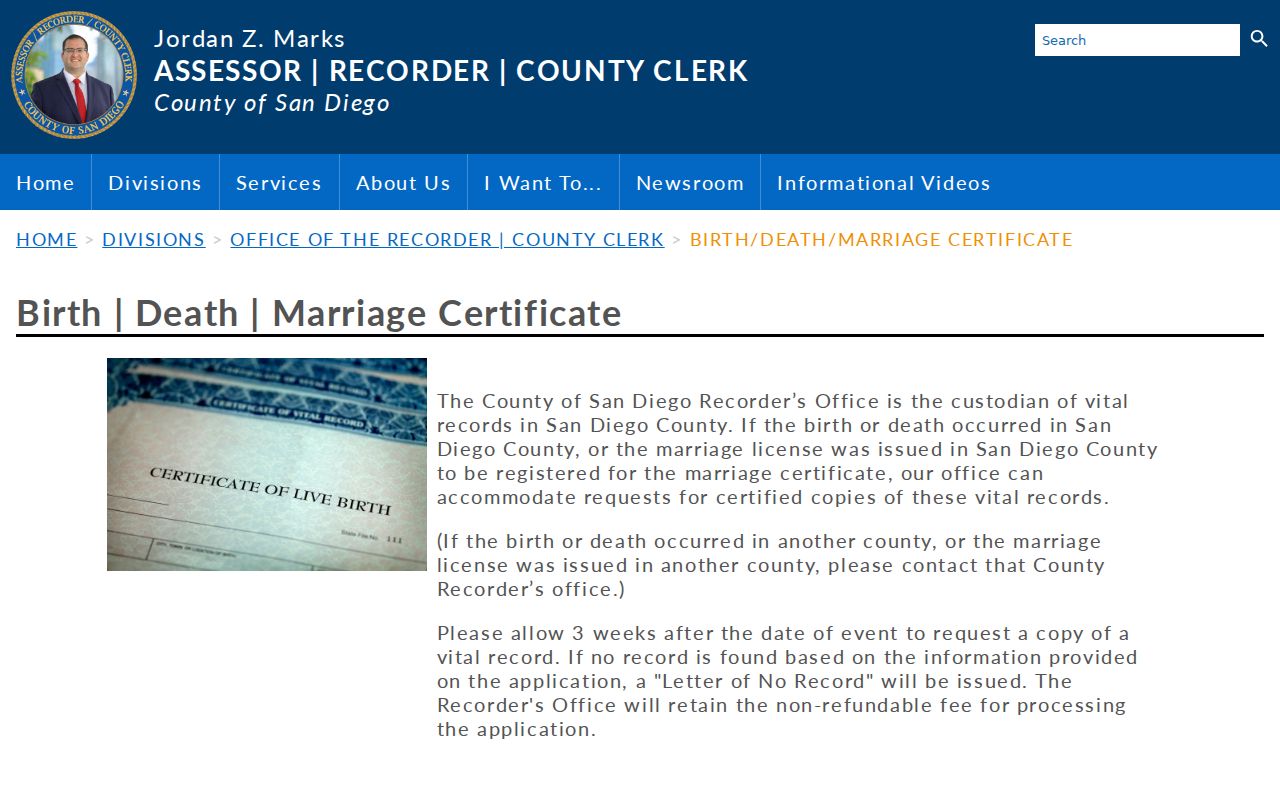
That county channel serves local events, while CDPH-VR provides a statewide route. Confidential marriage copies are different: CDPH does not keep them, and only the spouses or a person with a court order may obtain one from the county clerk that issued the license.
Oceanside Record Copy Costs
Recorder copies cost $2 for the first page, $0.05 for each added page, and $1 to certify a document. Card payment adds a $2.50 surcharge. The current county vital-record fees in the research are $34 for a birth certificate, $26 for a death certificate, and $19 for a public marriage certificate. State CDPH fees are $29, $24, and $17 respectively, with a $16 dissolution-of-marriage certificate.
Channel costs matter too. County online birth and death orders add a $12.95 processing fee, while regular mail shipping is listed at no cost and express delivery adds $19. Police records from Oceanside cost $5.50 per report. Sheriff crime, arrest, and accident reports cost $20, subject to the documented victim-copy exceptions.
- Index
- A list of identifying facts that points to a file, not necessarily the file image.
- Certified copy
- A copy authenticated by the custodian for an official purpose.
- Custodian
- The agency or office responsible for keeping and releasing a record.
- Exemption
- A legal reason an agency may withhold all or part of a requested agency record.
Oceanside Business Records Lookups
California splits business evidence across entity, trade-name, permit, and license systems. Secretary of State bizfile covers corporations, limited liability companies, and limited partnerships. County fictitious business names can connect a registrant, trade name, and address. DCA verifies licenses from its many boards, and the DCA advanced license search accepts a person name, business name, license or registry number, board, license type, location, and status.
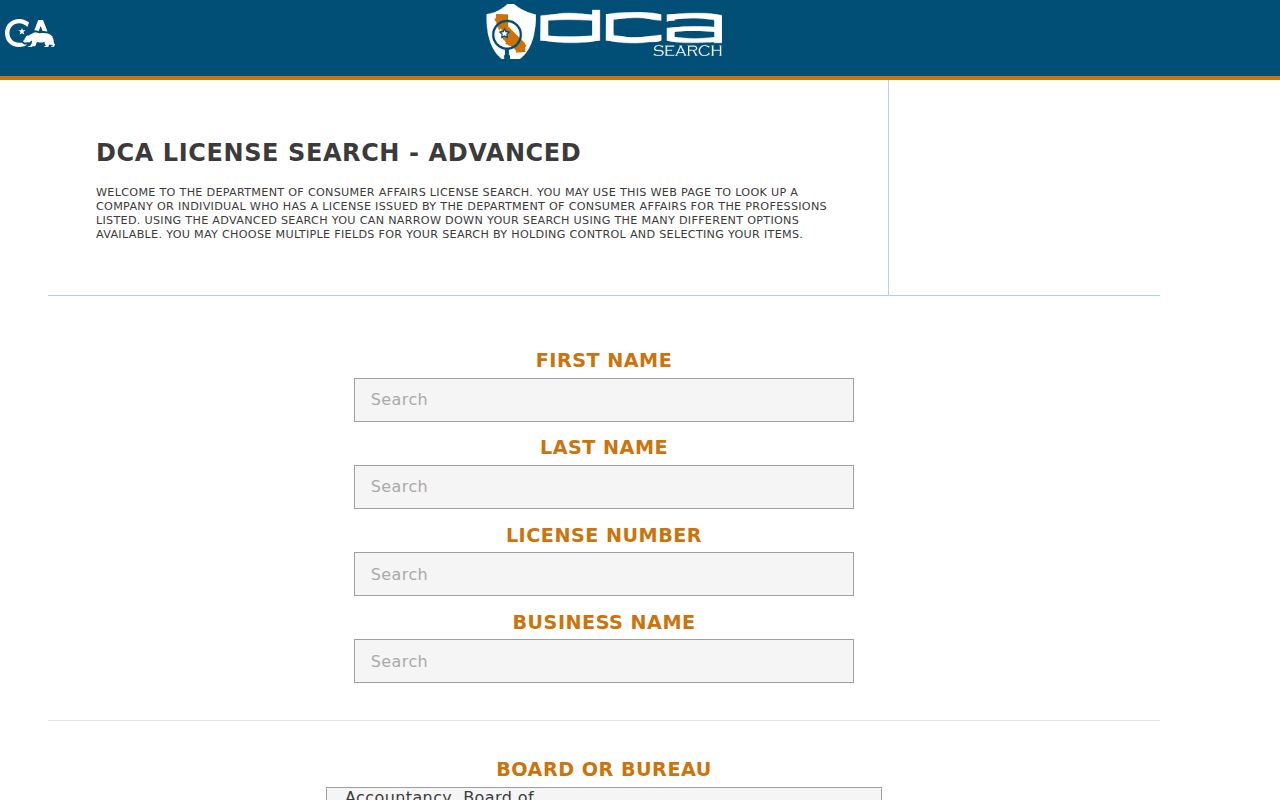
Those filters help distinguish similar names and confirm which California board issued the credential. The Secretary of State bizfile search is the companion source for registered entities.
Bizfile supplies the statewide entity trail, while an Oceanside permit or county trade-name filing may add local context that entity records do not contain.
Oceanside Custody Records Access
The San Diego Sheriff’s Who’s In Jail service is the county custody path for people booked into county facilities. A name search can begin with only the first two letters of the first and last names to reduce spelling conflicts. After the captcha, choose the matching last name to reach the custody page. The custody information line for all detention facilities is (619) 409-5000. The Sheriff also publishes a warrant query that accepts full or partial first, middle, and last names.
California prison custody uses CDCR’s CIRIS, while federal custody uses the Bureau of Prisons locator. Megan’s Law is narrower: it displays only registrants and offenses that California law allows the public site to disclose. It must be used for public safety, never to threaten or harass a listed person.
Note: A custody result reflects the system’s current status and should be confirmed with the agency before it is relied upon.
Oceanside Public Records Offices
Each desk below owns a different part of the Oceanside record system. Call before traveling when a kiosk, older volume, or hard-copy file is needed. County locations include a North County option in San Marcos, while a court file must be requested where the case is held.
Oceanside City Clerk
300 North Coast Highway
Oceanside, CA 92054
(760) 435-3000
San Diego Recorder/County Clerk
Official records, vital indices, marriages, and FBNs
(619) 237-0502
San Diego County Assessor
Ownership, address facts, parcel maps, and assessment roll
(619) 236-3771
File an Oceanside Records Request
The California Public Records Act, Government Code section 7920.000 and following, lets any person request identifiable state or local agency records unless an exemption applies. Under section 7922.535, the agency generally has ten days to determine whether it holds disclosable records and tell the requester its decision and reasons. Written notice may extend that determination by no more than fourteen days in unusual circumstances. This is a determination deadline, not a promise that every record will be produced within ten days.
- Name the right custodian. Send city material to Oceanside, recorder material to ARCC, and court files through court procedures rather than CPRA.
- Check the existing access route. Search the index, published request log, assessment roll, or other portal before filing a broad request.
- Describe identifiable records. Give useful names, date ranges, departments, addresses, case or document numbers, and record types.
- Choose delivery and copies. State whether electronic inspection is enough or whether plain or certified paper copies are needed.
- Review the response. If material is withheld, read the stated basis, narrow an overbroad request when useful, and seek agency review or legal advice when warranted.
Oceanside police reports use their department process, including in-person and mail routes. Recorder copies may be ordered online, requested by mail, or viewed at kiosks. Courts offer the index, public computers, Register of Actions, mail or counter requests, and Older Records. Vital copies use county or state forms. These channels remain essential when a web search stops at an index.
Lawful personal use. Open records support family research, estate work, civic review, consumer safety, and other lawful needs. Never use personal data to stalk, harass, threaten, or harm anyone.