
Check Oceanside Voter Registration
Begin at the San Diego County Voter Information Lookup. It is built for a voter to retrieve personal election details, not for someone to search a public voter roll by name. Choose the view you need, then supply the street address, ZIP code, and birth-date details tied to the voter registration. Address parts matter because the form separates a house number from the street name and its directional or street-type fields.
The lookup opens with four paths: Voter Information, Vote Centers, Voter Information Pamphlet, and Elected Representatives. A Return to Search control starts over. The exact form fields are:
| Lookup label | Input | Required | How the field works |
|---|---|---|---|
| Select Your Party Preference | Dropdown | Conditional | Options include the listed parties and No Party Preference. |
| House Number | Number | Yes | The label carries an asterisk. |
| Birth Date | Three dropdowns | No visible asterisk | Month, day, and year controls are generated by JavaScript. |
| Pre Direction | Dropdown or text | Optional | Use it only when the address has one. |
| Street Name | Text | Yes | The label carries an asterisk. |
| Street Type | Dropdown | Optional | Examples include Avenue and Street. |
| Post Direction | Dropdown or text | Optional | Use it only when the address has one. |
| Zip Code | Number | Yes | The field accepts no more than five digits. |
The captured county lookup screen shows why a correct Oceanside address is the core search key.
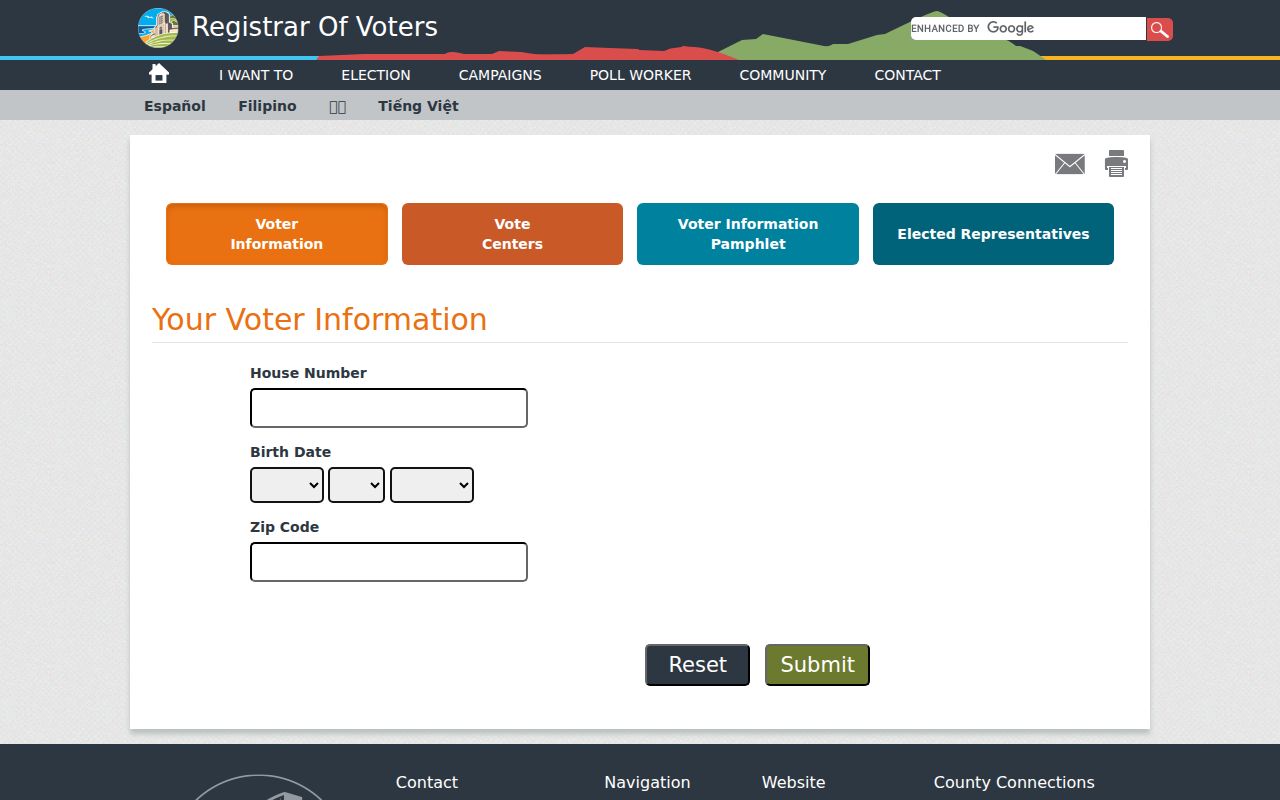
The form's address-first design reinforces its role as a private self-check, not a browseable people directory. If it does not resolve the entry, use the county Registrar's inquiry channel rather than trying name variants in an unrelated database.
Oceanside Voter Lookup Results
The county interface can present voter information, a vote-center view, the voter information pamphlet, and elected representatives. California's My Voter Status adds a statewide self-service route. It can show registration status, political party preference, language preference for election materials, and county elections contact details.
Election-specific results may include the polling place, ballot drop-off locations, and the status of a vote-by-mail or provisional ballot. These are personal status details. They do not turn the system into a general voter registration search for other Oceanside residents.
Note: A voting-history field records election participation only and never reveals the choices marked on a ballot.
Oceanside Voter Record Fields
California's VoteCal system is the central voter database, while San Diego County manages local registration and election service. Depending on the approved use and source, a voter record can contain the following fields. The list is an inventory, not a promise that each item appears in a self-lookup or released file.
| Identity | Full name and residence address, with a mailing address when different. |
|---|---|
| Preferences | Party preference, including No Party Preference, and language preference. |
| Election geography | Precinct, districts, vote center, and elected representatives. |
| Registration standing | Active, inactive, or cancelled context and record updates. |
| Ballot status | Vote-by-mail or provisional ballot status in the voter's self-lookup. |
| Participation history | Elections in which the voter participated, with no ballot choices. |
| Protected data | Full birth date and confidential-voter flags are withheld from routine disclosure. |
California keeps voter data restricted. Elections Code sections 2188 and 2194 and Government Code section 7924.000 control access to registration affidavit information. Full birth dates and confidential-voter details are not routine public fields, and some protected records are not released to approved requesters.
The key split is between data held in the voter system and data a given user is allowed to see. California does not treat all stored fields as open public records.
Oceanside Voter Rolls Are Restricted
A common myth is that voter registration is a public roll for finding any resident. California's Secretary of State says the information is not public data. Approved access depends on a stated purpose under Elections Code sections 2188 and 2194, Government Code section 7924.000, and the access rules in California Code of Regulations sections 19001 through 19013.
Authorized categories on the state application include election, political, scholarly, journalistic, governmental, and certain legal or investigative uses. An applicant must document the purpose. Personal curiosity, a commercial mailing list, or an open-ended people search does not become valid because a voter file exists.
The general rules for agency documents are addressed separately under the Oceanside public records system. Voter files have their own tighter election-law controls.
Oceanside Voter Status Changes
An active voter is registered, eligible to vote, and included in election-material mailing lists for each election in which eligible. The active record is also included in the Roster of Voters used at the assigned polling place on Election Day.
Inactive does not mean cancelled. An inactive voter remains registered and eligible to vote but does not receive election mail. California may place a voter on inactive status when returned mail or postal data indicates a possible move outside the state. The voter then receives a forwardable confirmation card.
Re-register after a move, legal-name change, or party-preference change. San Diego County says a Voter Notification Card is mailed after registration or re-registration so the voter can check the address and party preference. A cancelled record is a different status and should not be assumed from missed mail alone.
Safe at Home for Oceanside Voters
The California Secretary of State's Safe at Home program provides an address-confidentiality path for eligible protected participants. It uses a substitute mailing address so a participant can receive mail without placing a protected home address into routine public circulation.
Confidential voter records receive special handling. The voter-file application warns that some records are deemed confidential and will not be supplied to requesters. Elections Code section 2166.9 also limits access to confidential contact information for protected elected officials and candidates to bona fide journalistic or governmental purposes, subject to the Secretary of State's determination.
Note: Never infer an Oceanside voter's home address when the source displays a missing or protected field.
Request Oceanside Voter Registration Data
Oceanside records may be requested through the San Diego County Registrar of Voters or as part of a state, county, or district extract from the California Secretary of State. Both channels require a formal application. The request is reviewed against the permitted purpose and security rules before data is released.
- Choose the county voter registration data application or the state voter-file application based on the coverage needed.
- Identify the applicant and beneficiary, select an allowed purpose, describe the planned use, and complete the security certification.
- Attach the required purpose documents and identification. The state form requires a clear copy of a current driver license or state ID.
- Sign the original and submit it through the accepted channel with the fee. Approval must come before the data may be used.
County applications go to the San Diego County Registrar of Voters, 5600 Overland Avenue, San Diego, CA 92123. Email and fax are not accepted. State applications go by mail or hand delivery to the Secretary of State, 1500 11th Street, 5th Floor, Sacramento, CA 95814. The original signature is required.
Oceanside Voter File Costs
The Secretary of State reviews and processes an application in 7 to 14 business days. The researched state fee is $15 per thousand voter registration records, capped at $100. Specific voter records cost $30 each, capped at $100, and one application may identify no more than 10 specific voters.
| Request route | Submission | Charge and delivery |
|---|---|---|
| San Diego County data | Original county application by an accepted physical channel | Use the current county form for the applicable charge; email and fax are not accepted. |
| State, county, or district extract | Original state application, ID, purpose proof, and payment | $15 per thousand, up to $100; encrypted DVD with tab-delimited voter, history, and district files. |
| Specific voter records | State application with identifying details for up to 10 voters | $30 each, up to $100; encrypted WinZip attachment by email. |
Tab-delimited means each field is separated by a tab so database or spreadsheet software can import it. Encryption protects the file in transit and does not remove the requester's duty to keep it secure.
Oceanside Voter Record Use Limits
Approved data may not be repurposed, passed to another party without the required new application and written approval, used for harassment, used for advertising or marketing, or left unsecured online or offline. California Elections Code section 18109 makes unlawful use a misdemeanor and allows significant fines.
Permission follows the purpose. A voter-file approval does not grant broad reuse. Protect every copy, limit access to the approved work, and do not contact or target an Oceanside voter in a harmful way.
When the goal is a lawful family or estate search rather than an approved voter-file purpose, use a source meant for public name-and-address discovery. California's free unclaimed-property database can connect a name with a reported last-known address and holder. The assigned California State Controller claim search illustrates that separate public route.
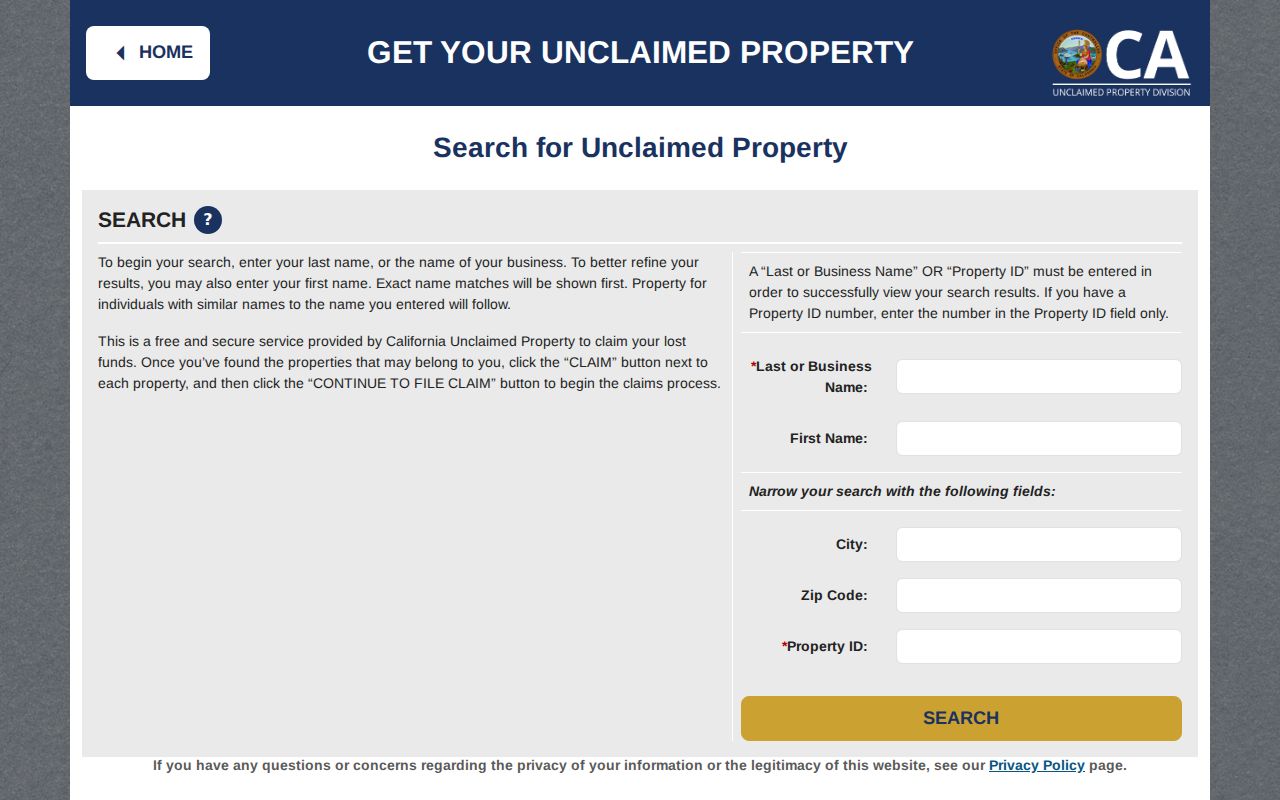
That screen is not a voter database. Its value here is the boundary it makes clear: when voter rolls are restricted, switch to a source authorized for public searching instead of trying to bypass election-law limits.
Historical Oceanside Voter Research
Modern self-service tools are poor fits for historical voter work. Older poll books and voter registers may survive through the California State Archives or county historical collections, but the research did not locate an official year-by-year inventory for San Diego County. Ask the archive to confirm holdings before planning a visit or copy request.
For context rather than individual entries, the San Diego County Registrar publishes monthly registration totals, language reports, and post-election turnout reports with a year selector reaching back to 1991. Those reports can show how the electorate changed, but they do not identify an Oceanside voter.
Historical records should be read in the setting of their time. Jurisdiction, precinct boundaries, address forms, and record practices change. Confirm identity with another dated source before treating a similar name as the same person.